First Move
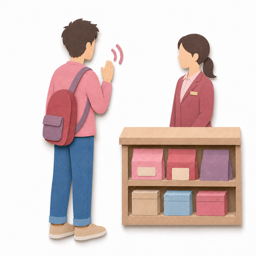
When you need someone’s attention, begin with “sumimasen.” The situation will usually explain the rest.
Quick steps
- To get attention: “Sumimasen” + your request.
- For a small apology: “Sumimasen.”
- After someone helps you, add “Arigatou gozaimasu.”
Say or show this
Use these phrases to speak or point when you need help.
Use it to get attention or acknowledge a small inconvenience.
Sumimasen.
すみません。
Excuse me, or sorry.
Show a name, photo, or map while asking.
Sumimasen, kore wa doko desu ka?
すみません、これはどこですか?
Excuse me, where is this?
Use when you did not understand what someone said.
Sumimasen, mou ichido onegaishimasu.
すみません、もう一度お願いします。
Sorry, one more time, please.
Use when someone goes out of their way to help.
Sumimasen. Arigatou gozaimasu.
すみません。ありがとうございます。
Sorry for the trouble. Thank you.
If You See or Hear This
Sumimasen, toorimasu.
すみません、通ります。
It means: Excuse me, I’m coming through.
Your move
Make a little space if needed.
Omatase shite sumimasen.
お待たせしてすみません。
It means: Sorry to keep you waiting.
Your move
Staff is acknowledging the wait. No special response is required.
Sumimasen, chotto…
すみません、ちょっと……
It means: Sorry, that may be difficult…
Your move
The unfinished sentence may be a soft way of saying the request is not possible.
If You’re Stuck
Do not worry about choosing the perfect English translation. The person, place, and timing do most of the work. At a counter it may mean “excuse me.” After a mistake it sounds like “sorry.” After someone helps, it can carry a feeling close to “thank you for the trouble.”
Tiny Culture Note
“Sumimasen” is less like one English word and more like a small social cushion. It acknowledges that you have entered someone else’s space, attention, or effort. That is why the same word can open a question, soften an apology, and finish an act of kindness.