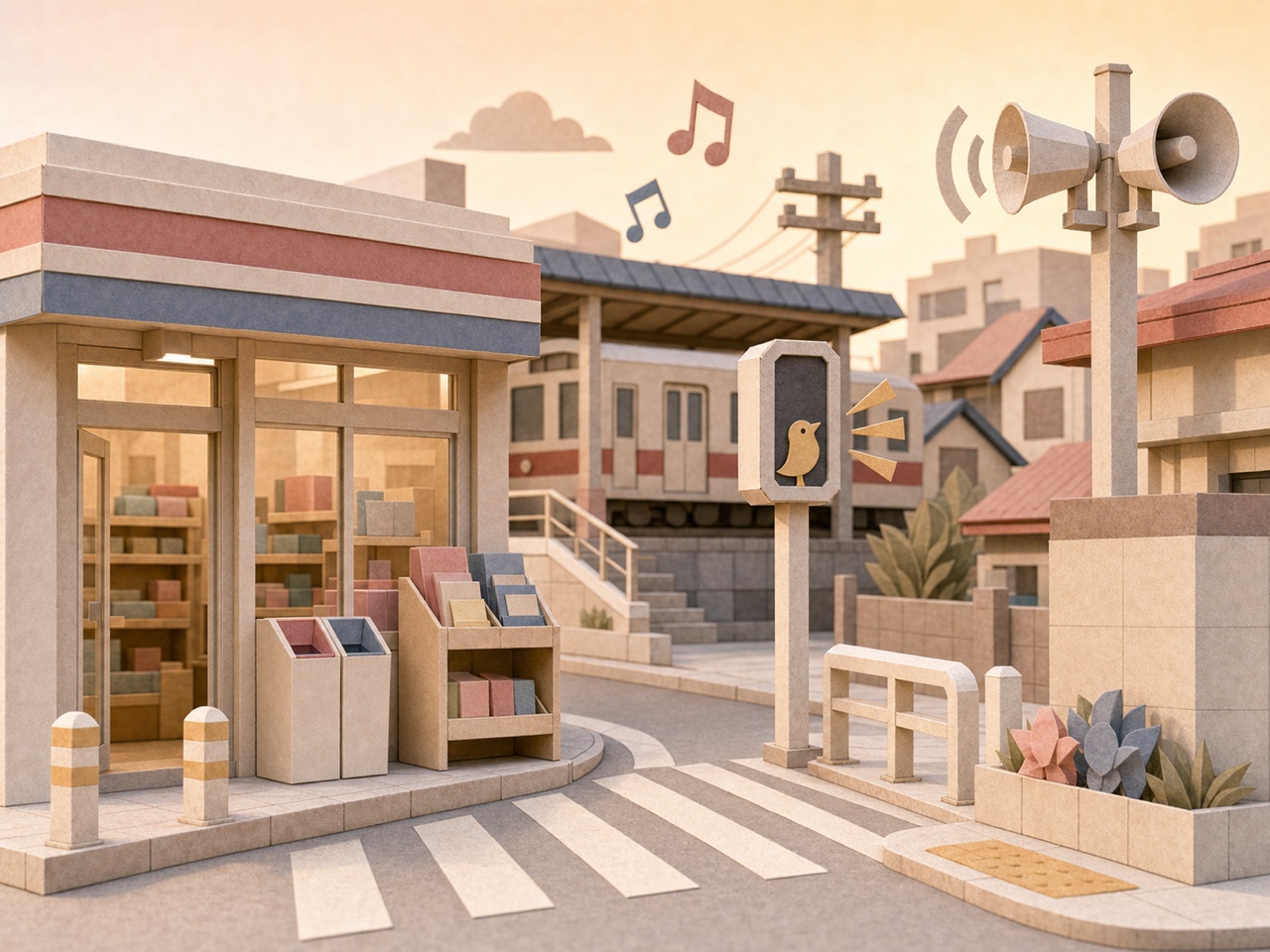
Some memories of Japan return as images. Others come back as sound.
A familiar door chime, a chirping crosswalk, or a melody drifting across a neighborhood at five in the afternoon.
You may barely notice them during your trip. Months later, one sound can bring the whole place back.
Japan is not as quiet as it first seems
Japan is often described as quiet. Trains are orderly, people rarely talk loudly on public transport, and residential streets can feel surprisingly calm.
But everyday Japan is full of sound.
Doors announce that someone has entered. Crosswalks chirp. Stations play short melodies. Supermarkets repeat cheerful promotions. In some neighborhoods, music drifts from outdoor speakers in the late afternoon.
Many of these sounds are not there simply for atmosphere. They guide people, give warnings, mark time, and make busy places easier to navigate.
Once you start noticing them, Japan develops its own soundtrack.
The sound that tells you a door has opened
Walk into a convenience store and you may hear a short electronic chime before you have even looked around.
For customers, it becomes part of the experience: the automatic doors slide open, the air conditioning hits, and the shelves of drinks, rice balls, and snacks appear.
For the staff, the sound has a practical purpose. It lets them know that someone has entered, even when they are stocking shelves or working behind the counter.
Not every store uses the same sound, but some melodies become so familiar that people instantly associate them with a quick stop at a convenience store.
During a trip, you might hear that chime several times a day without thinking about it. Later, it can bring back a very specific feeling: stepping inside late at night to buy a drink, breakfast for the next morning, or a snack you had never seen before.
Why crosswalks chirp
The “piyo-piyo” sound at some Japanese crossings may seem playful, but it is doing an important job.
Acoustic traffic signals help pedestrians—especially people with visual impairments—know when it is safe to cross. Japan commonly uses bird-like sounds, including chirping and cuckoo calls.
At some crossings, the sounds alternate from opposite sides of the road. This helps indicate the direction of the crossing rather than simply announcing that the light is green.
The result is a sound that is both functional and strangely memorable.
After a few days in Japan, you may stop consciously hearing it. Your feet simply learn that the chirping belongs to the moment when everyone starts moving.
Every station has its own rhythm
Japanese stations are full of small audio signals.
There are ticket gate beeps, platform announcements, warning sounds, train doors closing, and short melodies before departure. Together, they create a rhythm that regular passengers understand almost automatically.
Departure melodies can also give stations a little personality. Some are connected to local places, famous songs, or something the area is known for. Others are simply short tunes designed to be clear without feeling too harsh.
For a visitor, the information can feel overwhelming at first—especially when several announcements and melodies overlap.
But after taking the same route a few times, the sounds begin to feel useful. You recognize the melody before your train leaves. You hear the warning tone and know to step back. A station that once felt confusing starts to feel familiar.
Shopping has a soundtrack
Convenience stores are not the only shops with their own sounds.
Walk into a Japanese supermarket or drugstore and you may hear something different from every direction.
There are announcements for the day's recommendations, short promotions playing near particular shelves, staff calling out offers, and electronic beeps as products pass through the checkout.
The same melody may repeat until it is still in your head after you leave the store.
Even if you cannot understand every word, the energy alone makes it clear that something is being recommended.
The products may look calmly and carefully arranged, but listen closely and the store can be surprisingly lively.
Shopping in Japan is an experience made not only from what you see, but also from the sounds that follow you through the aisles.
A sound that marks the day
When the whole neighborhood hears the time
In some parts of Japan, a melody, chime, or siren plays through outdoor speakers in the late afternoon.
Visitors often call it the “five o'clock chime,” although the time, song, and purpose vary by municipality. Some areas change the broadcast time with the season and sunset.
For local children, it can be a signal that it is time to head home. For adults, it may simply mark the end of the afternoon.
The speakers are also part of municipal disaster-prevention systems. Regular broadcasts can help confirm that the equipment is working and ready for emergency announcements.
If you hear the melody while walking through a residential neighborhood, the effect can be oddly cinematic. The streets are quiet, the light is beginning to change, and a tune floats above the rooftops.
Nobody stops to listen. It is simply part of the day.
That ordinariness is what makes it special.
Sounds that mark the season
Not every familiar Japanese sound comes from a speaker.
Summer has cicadas, sometimes so loud that they seem to fill the entire street. Wind chimes ring outside windows and shops. Festival music travels through neighborhoods.
In winter, streets can feel much quieter, making temple bells, crossing signals, and distant train sounds stand out more clearly.
These sounds do not appear everywhere in exactly the same way. Japan's soundtrack changes with the city, the neighborhood, the weather, and the season of your visit.
That means your memory of Japan may sound different from someone else's.
The sounds are doing a job
It is easy to describe these sounds as charming, but they are not always gentle.
Stations can be noisy. Shops sometimes play several announcements at once. After a long day, the constant voices, beeps, and melodies may feel tiring—especially when you are still trying to understand what everything means.
But most of the sounds are there for a reason.
They tell staff that someone has entered. They help pedestrians cross safely. They keep passengers aware of departing trains. They share local information and make public systems easier to follow.
Japan has many unspoken rules, but it also has plenty of audible guidance.
The city is quietly telling you what is happening next.
Once you notice them, Japan sounds different
At first, these sounds may feel like background noise.
Then you begin to recognize them.
The door chime means a cold drink and a few minutes under bright convenience-store lights. The crosswalk chirp means moving with the crowd. A station melody means your train is about to leave. An evening broadcast means the day is slowly winding down.
When you return home, you may find that these ordinary sounds stay with you longer than expected.
One day, you hear something similar in a video, a shop, or a station. For a moment, you are back on a Japanese street—carrying a supermarket bag, waiting at a crossing, or walking to your hotel as the evening melody plays somewhere in the distance.
You may not miss the announcement itself.
You may miss the ordinary moment that was happening around it.