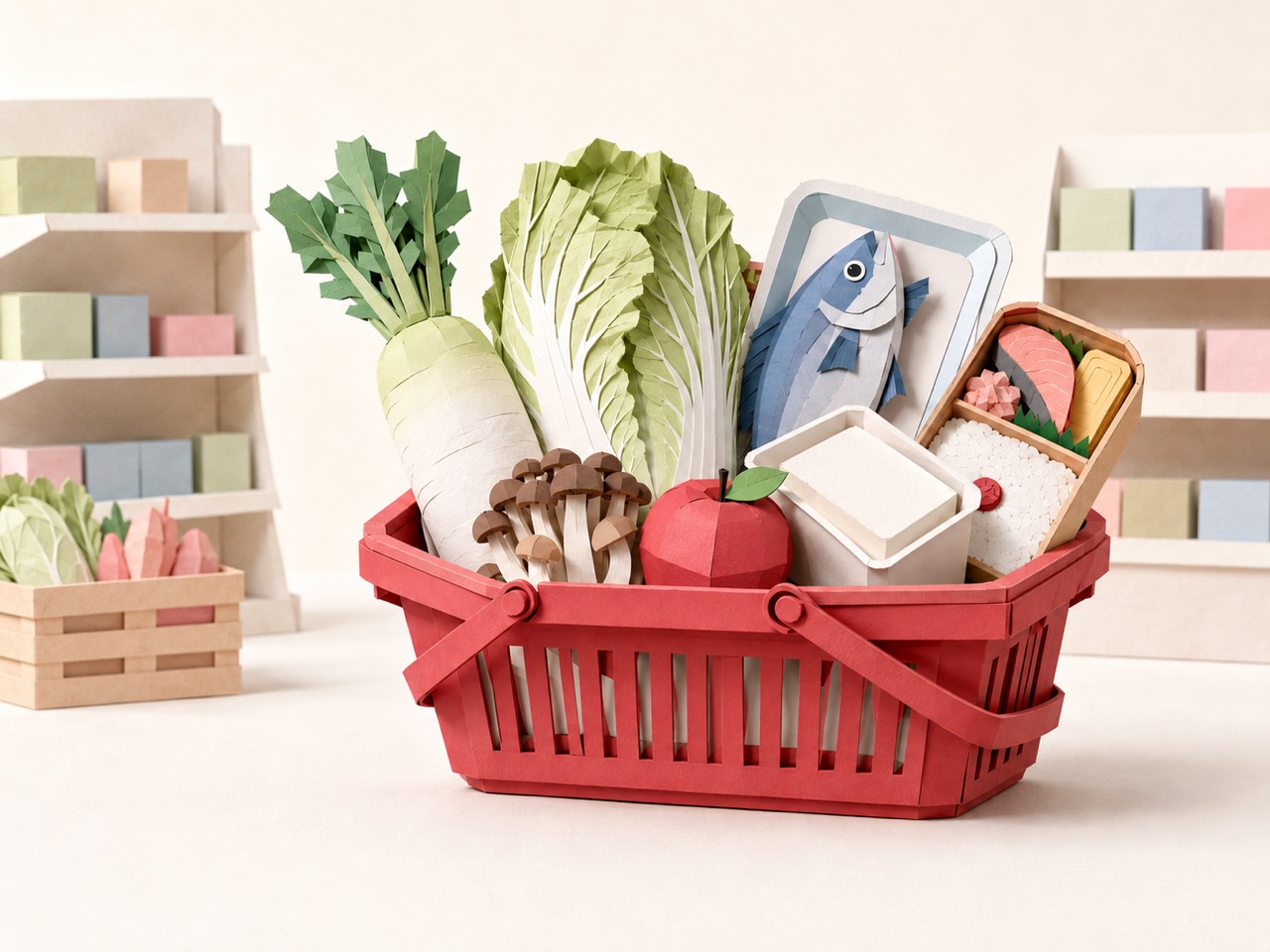
A Japanese supermarket is an ordinary place. That is exactly what makes it interesting.
Nobody has arranged the shelves to explain Japan to visitors. The store is simply serving the people who live nearby. Walk through one slowly, and you can see how everyday meals come together: what is in season, which ingredients people use regularly, and what they cook—or decide not to cook—after a long day.
Some products will look familiar. Others may leave you with no idea what you are looking at.
That is not a problem to solve immediately. Meeting something unfamiliar is one of the best parts of travel.
A supermarket is not just a bigger convenience store
Convenience stores are built for speed. They are useful when you need one drink, one meal, or one missing item without changing your plans.
Supermarkets give you a wider view of daily food life. You will find fresh vegetables, seafood, meat, tofu, noodles, seasonings, frozen food, household ingredients, and a much larger prepared-food section.
The difference is not about which one is better.
A convenience store helps you solve the next few minutes. A supermarket lets you see how everyday meals come together.
The shelves tell a story
Some sections will feel familiar. Others may take longer to understand.
Near the refrigerated shelves, you might find several kinds of tofu, natto, konnyaku, pickles, fish cakes, fresh noodles, miso, and small side dishes. The seasoning aisles can contain different types of soy sauce, vinegar, dashi, sesame dressing, cooking sake, and sauces designed for particular dishes.
These are not necessarily special delicacies. Many are ordinary ingredients that make everyday cooking easier.
You do not need to recognize everything. Look at the packaging, notice what takes up the most shelf space, and see what other shoppers put together.
Sometimes not knowing is what makes the aisle interesting.
A local observation
The seafood counter may surprise you
For me, the biggest difference between Japanese supermarkets and many supermarkets overseas is the seafood counter.
The variety can be remarkable: whole fish, fillets, shellfish, sashimi, and cuts prepared for grilling, simmering, or other dishes. The selection changes with the season and region, so even familiar stores do not always look the same throughout the year.
What may be even more surprising is the smell—or the lack of it.
Even with so much fresh seafood on display, there is often very little fishy smell. It is one of those everyday details that people living in Japan may barely notice, but visitors might find genuinely impressive.
You do not need to buy sashimi to appreciate the section. Simply looking at the range of fish and how each one has been prepared can tell you a great deal about everyday food in Japan.
Why there is so much prepared food
The prepared-food section is often one of the busiest and most colorful parts of the supermarket.
You may see bento, sushi, grilled fish, karaage, croquettes, tempura, gyoza, salads, simmered vegetables, tamagoyaki, noodles, and small portions of side dishes.
This does not simply mean that people do not cook. A shopper might make rice and soup at home, then buy one prepared side dish. Someone else might cook the main dish and pick up a salad. Cooking and prepared food are not opposites.
In a 2024 survey by Japan’s Ministry of Agriculture, Forestry and Fisheries, 39.7% of respondents said they prepared meals while incorporating some commercially prepared food.
Prepared food is not just an emergency option. It is part of how many everyday meals are assembled.
Freshness, seasons, and different-sized choices
Japanese supermarkets change noticeably with the seasons.
Fruit, vegetables, fish, sweets, drinks, and prepared dishes may appear for only part of the year. Stores also build displays around seasonal events and local eating habits.
Package sizes may be different from what you expect. Small portions for one meal can sit beside larger family packs. This is useful for travelers, but it also reflects the range of households the store serves.
Not every supermarket follows the same pattern. A large suburban store, a compact supermarket near a station, a premium food hall, and a regional chain can feel very different.
That means visiting another supermarket is not necessarily repeating the same experience.
Try it tonight
What to try at your hotel tonight
A supermarket is an easy place to create a small tasting experience without booking another restaurant.
Look for food that can be eaten cold or needs very little preparation:
- Inari sushi or simple makizushi
- Tamagoyaki
- A small prepared side dish
- Karaage, croquettes, or grilled fish
- Seasonal fruit or dessert
- Bread or sweets from a local producer
- A regional milk drink, tea, or juice
You do not need to build a perfect Japanese meal. Choose two or three things that look interesting.
Before buying hot or refrigerated food, check whether your hotel has a refrigerator or microwave. Follow the storage instructions and use-by date on the package, and avoid carrying perishable food for a long time.
The goal is not to find the “best” supermarket food. It is to try something that could be part of an ordinary evening in that neighborhood.
What might be in an everyday grocery basket?
There is no single typical Japanese grocery basket.
A student living alone, a family with children, and an older couple will not shop in the same way. Region, budget, season, and available time also change what people buy.
Still, one possible basket for a simple meal might contain:
- Rice
- Tofu or natto
- Seasonal vegetables
- Fish, meat, or eggs
- Ingredients for miso soup
- Pickles or another small side dish
- Tea, yogurt, or fruit
- One prepared item to save time
The interesting part is often the combination.
Instead of asking, “Is this what Japanese people eat?”, try asking, “How could these ingredients become tonight’s meal?”
One more aisle
Then there is the tea aisle
The tea section can be a different kind of surprise.
Sencha, hojicha, genmaicha, matcha blends, barley tea, tea bags, loose leaves, and bottled versions can fill an entire section.
The choice is impressive—right up until you actually have to choose one.
If I were visiting Japan for the first time, I would probably stand there for ten minutes wondering where to begin.
You do not have to understand every label. Start with a tea you recognize, choose a small package, or simply pick one aroma or style that sounds interesting. Even an uncertain choice can become part of the trip.
Small discoveries worth taking home
A supermarket can be a good place to find items made for daily use rather than for the souvenir market.
Look for small, shelf-stable products such as:
- Furikake rice seasoning
- Tea
- Instant miso soup
- Dashi packets
- Sesame, yuzu, or shichimi seasonings
- Local curry, noodles, or soup mixes
- Regional snacks
- A supermarket’s private-label products
Seasonal and regional shelves are especially worth checking.
The item does not need to be expensive or officially “rare.” Sometimes the most memorable discovery is an ordinary product you would never have noticed in a souvenir shop.
Before packing food: Import rules depend on your destination. Check the customs and agricultural rules for meat products, fresh produce, seeds, and other potentially restricted foods. Liquids may also need to go in checked baggage.
Discount stickers and unfamiliar ingredients
Later in the day, you may notice discount stickers on prepared food, meat, fish, bakery items, or desserts.
The timing and amount vary by store, so there is no guaranteed hour for finding a bargain. More interestingly, the stickers reveal which products are prepared fresh and expected to sell that day.
Also notice the products that occupy a surprisingly large amount of shelf space. Several kinds of miso, tofu, seaweed, noodles, or bottled sauce may look repetitive at first. Look closer and you may find differences in region, flavor, ingredients, or intended use.
Imported food is available in Japan, especially in larger or specialty stores. But an ordinary supermarket arranges its shelves for local customers. Familiar products from home may have less space than you expect, while something you have never seen before may have an entire section.
That difference is part of the fun.
What to notice on your next visit
You do not need a detailed shopping list. Start with a few questions:
- What food is being promoted as seasonal?
- Which prepared dishes seem popular?
- What is sold in more varieties than you expected?
- Which products appear to be local?
- What do other shoppers combine in their baskets?
- What could you try tonight without needing a kitchen?
Spend ten extra minutes looking instead of searching only for something familiar.
There is no single version of everyday Japan
A supermarket reflects its neighborhood.
Stores near stations may emphasize small meals for commuters. Suburban stores may offer larger packs and wider household sections. Regional chains may carry local vegetables, seafood, seasonings, sweets, and prepared dishes that are difficult to find elsewhere.
Prices, products, and shopping habits vary by household, region, generation, store, and season. No single supermarket can show you how everyone in Japan eats.
But it can show you one small piece of daily life in that place.
A Japanese supermarket will not explain itself like a museum. It will simply continue with the ordinary work of feeding the neighborhood.
Walk in, choose something unfamiliar, and see where it takes you.