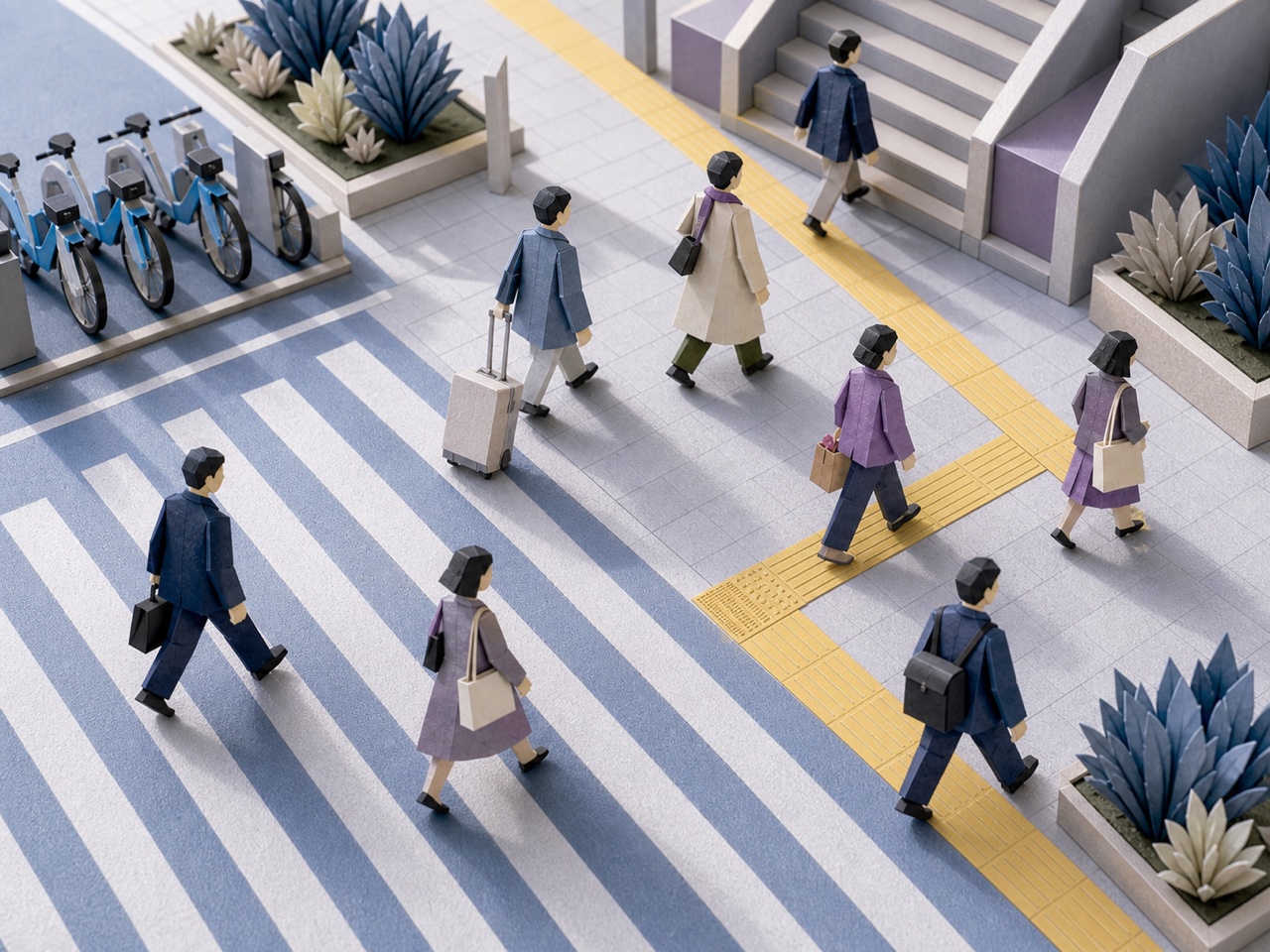
You may notice it in your legs before you notice it anywhere else.
A day in Japan can quietly turn into 15,000 steps. You walk to the station, through the station, between platforms, out of the wrong exit, back to the right exit, and then another ten minutes to wherever you were actually going.
It can feel like a lot—especially if you thought taking the train meant you would not be walking much.
But in many Japanese cities, walking is not a separate activity. It is simply how daily life connects.
The train does not replace walking
Japan’s railway network makes it possible to travel long distances without a car. But trains only take you part of the way.
People still walk from home to the station, change platforms, climb stairs, pass through underground passages, and continue from the final station to work, school, shops, or restaurants.
A station that looks like one point on a map can feel like a small town once you are inside it. Some transfers take much longer than expected, and the nearest exit is not always near your destination.
The train ride might be ten minutes. The walking around it can easily take longer.
Everyday errands often happen on foot
In walkable neighborhoods, daily necessities are often scattered along familiar routes.
A convenience store near the station. A supermarket on the way home. A pharmacy around the corner. A small restaurant beneath the railway tracks.
Instead of driving to one large shopping area, people may pick things up while moving through the neighborhood. Walking becomes part of buying dinner, meeting a friend, going to work, or taking a child to school.
It does not always feel like exercise. It is just built into the day.
Stations make you walk more than you expect
For travelers, stations are probably responsible for many of the surprise steps.
Large stations can have multiple train companies, underground shopping streets, long transfer corridors, and exits that lead to completely different parts of the neighborhood.
Choosing the wrong exit may add another ten minutes. Following a sign for your train may involve stairs, escalators, and a long passage before you even reach the platform.
This is normal. Even people who live in Japan can get confused in an unfamiliar station.
Look between the destinations
Walking changes what you notice
There is another reason walking matters: it slows Japan down enough to see it.
From a train window, a neighborhood passes in seconds. On foot, you notice the bicycles outside an apartment, the tiny garden beside a house, the evening queue at a bakery, and the sound of children heading home from school.
You begin to understand how close together ordinary life can be. Homes, train lines, supermarkets, shrines, vending machines, and small businesses often share the same few streets.
These are not famous sights. But they may become some of the clearest memories of your trip.
Not everywhere in Japan is highly walkable
Japan is not one continuous pedestrian-friendly city.
In rural areas and some suburbs, cars are essential. Shops may be far apart, buses may be infrequent, and the nearest station may not be within easy walking distance.
The image of Japan as a place where everyone walks mainly comes from dense cities and neighborhoods built around railway stations.
Where you stay makes a big difference.
Save your feet
A few things travelers learn quickly
Comfortable shoes matter more than stylish ones.
Distances inside stations do not always appear clearly on maps. Rain, summer heat, luggage, and crowded platforms can make a short route feel much longer.
It also helps to check the station exit before arriving. Exit numbers are not a minor detail—they can save you from walking around an enormous block.
If your destination is a little too far to walk, a rental bicycle can be a useful middle option. Bike-sharing is available in many cities, but check the parking areas and local cycling rules before setting off.
And if you have a full day planned, leave some energy for the walk back to your hotel. Japan has a habit of adding one last staircase when you thought you were finished.
Walking becomes part of the memory
At first, all the walking may feel tiring. A few days later, you may start to enjoy the rhythm of it: stopping at a convenience store, following the railway line, finding a quieter street, or recognizing the route back to your hotel without checking your phone.
Walking is not just how you move between places in Japan.
It is often how you begin to understand the places in between.