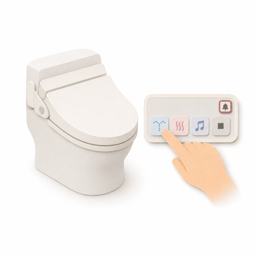
Go Ahead—Press the Buttons on a Japanese Toilet

Japanese toilets are famous for having more buttons than some elevators: heated seats, water jets, adjustable pressure, adjustable position, privacy sounds, and automatic flushing.

You could ignore all of it and use the toilet normally. But where is the fun in that? Most of the buttons are there to make the experience more comfortable. Once you know two important controls, you can sit down and start experimenting.

First Move

Find 止 and 呼出 first. One stops the adventure. The other calls a real person. After that, try the buttons.

Quick steps

  1. Find 止. Leave 呼出 for situations where you really need help.
  2. Sit down, try the other buttons, and press 止 to stop.
If You See or Hear This

Tome It means: Stop. Your move Remember this one first. It stops the washing function.
Oshiri It means: Rear wash. Your move Press it while seated and meet the feature Japanese toilets are famous for.
Bide It means: Bidet wash. Your move This provides a gentler front wash.
Jaku / Kyou It means: Weaker / Stronger. Your move Adjust the water pressure. Starting with 弱 makes the surprise slightly less dramatic.
Mae / Ushiro It means: Forward / Back. Your move Adjust the position of the water jet.
Oto / Ryuusui-on It means: Sound / Flushing-water sound. Your move Press it for a little extra privacy. It plays water sounds but does not necessarily flush the toilet.
Nagasu It means: Flush. Your move This is the actual flush control. It may also be a lever or wall sensor.
Yobidashi It means: Call for assistance. Your move This may alert staff or call for help. Save it for when you really need assistance.

If You’re Stuck

Press 止. That is the universal escape button for the wash functions. If nothing happens when you press a wash button, sit properly on the seat; many toilets use a seat sensor. If you hear flushing sounds but the toilet has not actually flushed, you may have activated the privacy sound. Look for a separate 流す button, lever, or sensor.

Tiny Culture Note

The privacy-sound feature is often associated with the name Otohime, or “Sound Princess.” It was developed because some people repeatedly flushed real water to cover bathroom sounds. Playing a recording provided the same privacy while using less water. A Japanese toilet may be the only travel experience where getting sprayed unexpectedly still counts as cultural discovery.

Stay in the same situation area, or go back to the category page and choose the closest moment.